Bluehost and WP Engine both offer WordPress hosting, but at very different price points. One is the budget generalist that’s officially recommended by WordPress.org. The other is the premium WordPress-only platform, focused on speed, security and developer tools. This Bluehost vs WP Engine comparison looks at pricing, performance, features and support so you can work out whether the extra cost is actually worth it.
Also Read: How to Transfer a Domain from Squarespace to Hostinger
Bluehost vs WP Engine at a Glance
The Quick Overview
Bluehost offers shared, cloud, and managed WordPress hosting, with entry-level plans around $3.99/month. WP Engine is purely a managed WordPress provider with plans from around $25 to $30/month. That price difference at the entry level is around seven to eight times, which is why most people will ask whether that premium is worth it.
Who Each Host Targets
Bluehost is aimed at the beginner, the blogger and the small business. WP Engine is aimed at the growing business, the agency and the high-traffic site where uptime and speed are effectively a revenue stream. The review sites reflect that split, with many coming down on the side of Bluehost as the better choice for most users and WP Engine as the better choice for sites where performance is absolutely critical.
Managed WordPress Hosting Comparison: What You Are Really Buying
Bluehost: A Broad Host with WordPress Focus
Bluehost offer a range of hosting options. Their basic plans are shared hosting with WordPress pre-installed, and they also have managed WordPress and agency plans for sites that require it. That flexibility allows you to start off cheap and then upgrade as and when you need to without having to leave the company.
WP Engine: A WordPress-Only Platform
WP Engine does one thing really and truly: it’s managed WordPress. The entire infrastructure, the caching (EverCache), the support and the tooling are all optimized for WordPress. That specialization is what you pay for in a managed WordPress hosting comparison, and it’s also what means you can’t actually host any other kind of site on there.
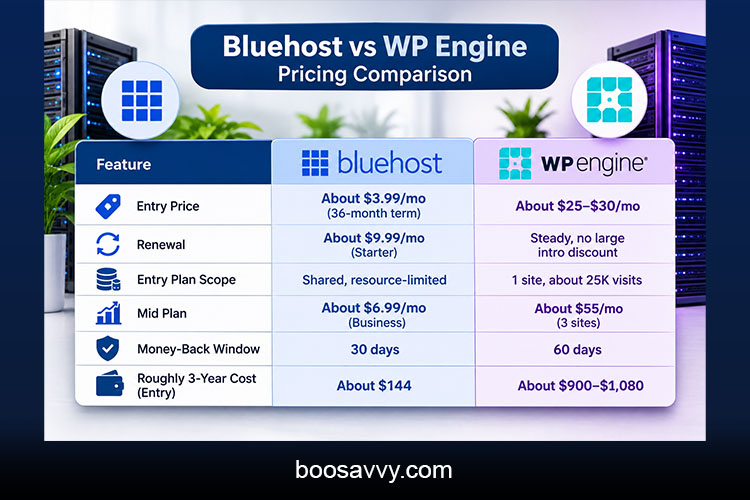
Bluehost WP Engine Pricing Comparison
Bluehost Plans
Bluehost’s shared WordPress plans start at $3.99/month on a 36-month term for Starter, $6.99 for Business and $14.99 for Premium (according to a 2026 pricing guide). Renewals are at approximately $9.99, $13.99 and $21.99, respectively. You should always check the Bluehost site as their managed plans are subject to frequent change.
WP Engine Plans
WP Engine’s Startup plan is around $25-$30 a month for one site and around 25k visits. Professional is about $55 for three sites. Growth is around $109 for ten. Scale is around $276 for thirty. Any additional sites are generally around $20 a month each.
| Entry price | About $3.99/mo (36-month term) | About $25–$30/mo |
| Renewal | About $9.99/mo (Starter) | Steady, no large intro discount |
| Entry plan scope | Shared, resource-limited | 1 site, about 25K visits |
| Mid plan | About $6.99/mo (Business) | About $55/mo (3 sites) |
| Money-back window | 30 days | 60 days |
| Roughly 3-year cost, entry | About $144 | About $900–$1,080 |
Prices will vary depending on the plan, the term, and any promotion, so be sure to check the current rates at checkout.
Renewals and Hidden Costs
Bluehost: Renewals and Upsells
Bluehost’s low price is predicated on a renewal price which jumps up to around $10/month. The checkout page is full of add-ons (backups, scanning, domain privacy, etc.) which one source puts at $5-$10 a month. Even with those add-ons, three years of Bluehost will still cost a fraction of what WP Engine will cost.
WP Engine: Visit Caps and Add-Ons
WP Engine has a more stable pricing structure, albeit one that’s traffic-based. You get visit allowances, an extra site at around $20 and a number of optional add-ons which can quickly drive the cost up as your site grows. Bluehost’s own marketing goes out of its way to criticise WP Engine’s traffic-based pricing, which is of course a vendor point of view that you would be well advised to consider in the light of Bluehost’s own constraints.
Speed and Performance
What Tests Show
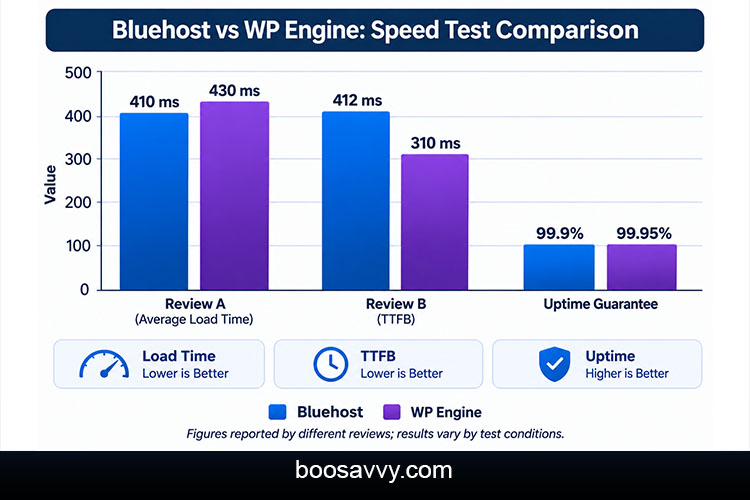
Performance is actually pretty mixed, and a lot of the comparison sites have affiliate programmes, so you need to be very careful what you read. One 2026 review averaged 410ms for Bluehost versus 430ms for WP Engine and described both as being excellent. Another review measured time to first byte at 412ms for Bluehost and 310ms for WP Engine (a clear win for WP Engine). A third review found Bluehost lagging the field in terms of raw performance and went on to name WP Engine as its top pick.
The pattern is that WP Engine is generally equal or faster; just the margin is smaller than the price gap.
Why Results Differ
Test location, plan tier, theme, plugins and caching all have an effect on the numbers. Bluehost reviewers point to their Cloudflare CDN and NVMe storage as the reasons for the good results at a low price, whereas WP Engine’s edge is down to its caching and managed environment.
| Average load time (review A) | 410 ms | 430 ms |
| TTFB (review B) | 412 ms | 310 ms |
| Uptime guarantee | 99.9% | 99.95% |
| Caching | NGINX-based cache, Cloudflare CDN | EverCache |
Uptime and Reliability
Both hosts perform pretty much the same. One comparison puts Bluehost’s uptime at 99.9% and WP Engine’s at 99.95%. The difference is negligible; really, it’s just around 4 hours a year of downtime allowed (vs 4.5 hours), so it’s only going to be a significant factor for sites where uptime is absolutely critical to revenue. For a blog or small business site, either would be fine.
Bluehost vs WP Engine for WordPress: Features and Tools
Caching and CDN
WP Engine has its own EverCache and a suite of advanced security tools. Bluehost uses NGINX-based caching with a Cloudflare CDN. Both are very good at handling WordPress, and both are fast enough for the sort of content sites you’d typically have.
Developer Tools and Staging
WP Engine has staging environments, developer-friendly tooling and a range of integrations and is known to provide access to dozens of premium StudioPress themes. Bluehost has staging on their higher tier plans and easy WordPress installation too, though their toolset is less developer-focused.
Flexibility
Bluehost allows you to run multiple sites on their higher plans and gives you the option of using other hosting types (including cloud). WP Engine is WordPress only, and sites are priced either individually or in bundles.
Ease of Use and Dashboard
Bluehost uses a custom dashboard with cPanel access, which is very much the standard for anyone who has used traditional hosting. WP Engine has a much more specialist dashboard, and one of the reviews mentions that there is a learning curve. If you’re just setting up your first site, then Bluehost is the easier option. If you’re managing multiple sites or working in a team, then the tooling that WP Engine provides is well worth it.
Customer Support
Bluehost has 24/7 chat and phone support, and the WP.org recommendation is a trust signal. WP Engine have 24/7 support, though there’s some variation in the reports as to whether you can get phone support. One comparison states you can’t get any phone support at all; others say it’s only available on higher plans. If it’s important to be able to talk to someone on the phone, then you’ll want to check what WP Engine’s current support offering is for your plan.
WP Engine’s 60-day money-back guarantee is double Bluehost’s 30 days, so you have more time to test.
Security and Backups
Both offer SSL and automated backups. WP Engine is known for its suite of security tools and for having a team that actively monitors threats (some of the more advanced security features are chargeable). Bluehost covers the basics and then sells you more robust scanning and backup add-ons. Whatever host you go with, you should have an offsite backup of your own.
WP Engine or Bluehost? Who Should Choose Which
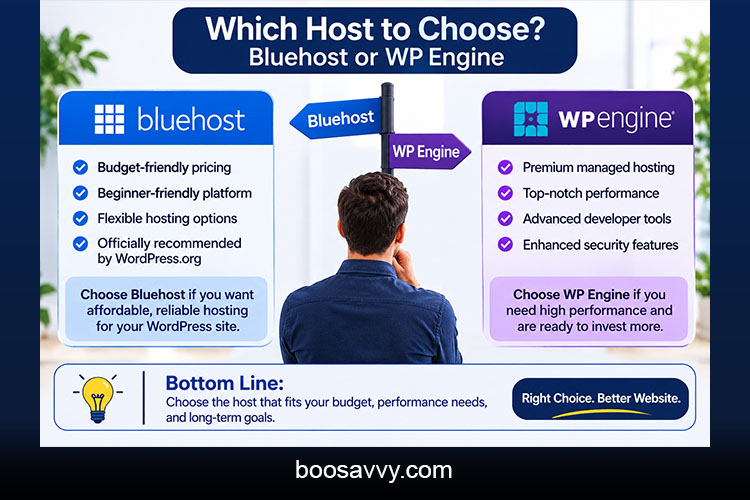
Choose Bluehost If You
- Are launching a blog or small business site on a budget
- Want phone support and a beginner-friendly setup
- Plan to start small and upgrade later
Choose WP Engine If You
- Run a revenue-critical, high-traffic or WooCommerce site
- Manage multiple client sites as an agency
- Value developer tooling, staging and a longer refund window
Conclusion
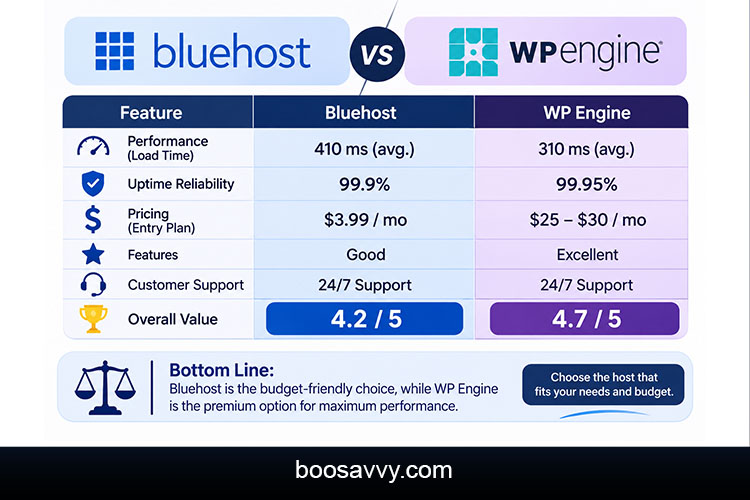
In the Bluehost vs WP Engine debate, the simple truth is that Bluehost wins on value and WP Engine wins on specialisation. Bluehost is a hell of a lot cheaper, includes phone support and is fast enough for pretty much any site. WP Engine is several times more expensive, but it comes with WordPress-specific infrastructure, developer tools, and a longer money-back period, which makes it much more attractive to agencies and for mission-critical sites.
For the average blog or small business, Bluehost is the way to go. If you’re running a site that actually makes money or you have a number of clients, then the premium of WP Engine is much easier to justify. Whatever you choose, look at the 3-year cost, check the renewal and the visit limits and use the money-back period to test the speed and the support for yourself.
FAQs
1. Is Bluehost better than WP Engine?
Bluehost is better for budget and beginners, while WP Engine is better for high-traffic sites, agencies and developer workflows.
2. Is WP Engine worth the extra cost?
It can be for revenue-critical sites and agencies. For small blogs, the performance gap rarely justifies roughly seven to eight times the entry price.
3. Bluehost vs WP Engine: which is faster?
Results vary. Some tests show WP Engine ahead, while others show them nearly equal, so test your own site during the refund window.
4. How much does Bluehost cost compared with WP Engine?
Bluehost starts around $3.99 a month, while WP Engine starts around $25 to $30. Confirm current prices at checkout.
5. Which host is better for WordPress?
Both are strong. Bluehost is officially recommended by WordPress.org, and WP Engine is a WordPress-only managed platform.
6. Does WP Engine have phone support?
Reviews disagree. Some say it has none, while others say it is limited to higher plans, so check your plan.
7. Which has the longer money-back guarantee?
WP Engine offers 60 days, while Bluehost offers 30 days.
8. Can I host multiple sites on each?
Bluehost allows multiple sites on higher plans. WP Engine prices sites individually or in bundles, with extra sites costing about $20 a month each.
9. Is Bluehost good for agencies?
Bluehost markets agency hosting with predictable per-site pricing, while WP Engine ties plans to visit limits. Compare both against your client load.
10. Can I migrate from Bluehost to WP Engine later?
Yes. WordPress sites are portable, and both hosts offer migration tools or help.