Choosing between two of the top recommended WordPress hosts is harder than it looks. Both are endorsed by WordPress.org, both promise a simple setup, and both are very much in the “look at this low introductory price” camp. But the real choice is price versus value: the differences emerge in the renewal price, the speed tests and the quality of the support if things go wrong. This SiteGround vs Bluehost guide looks at each of those factors in turn with actual figures.
Also Read: Best Cloud Server Hosting: Top Providers Compared In 2026
SiteGround vs Bluehost at a Glance
SiteGround is a premium choice, offering responsive customer support, Google Cloud infrastructure, and a user-friendly custom dashboard. Bluehost is a more budget-friendly alternative, ideal for beginners launching WordPress websites, with attractive introductory pricing and extended promotional plans.
One comparison site gave SiteGround 4.7/5 compared to Bluehost’s 4.2, but that only tells half the story. The real question is whether you care more about the first-year cost or the long-term performance and support.
SiteGround or Bluehost: Who Each Host Is For
If you’re going to SiteGround or Bluehost, start with who you are.
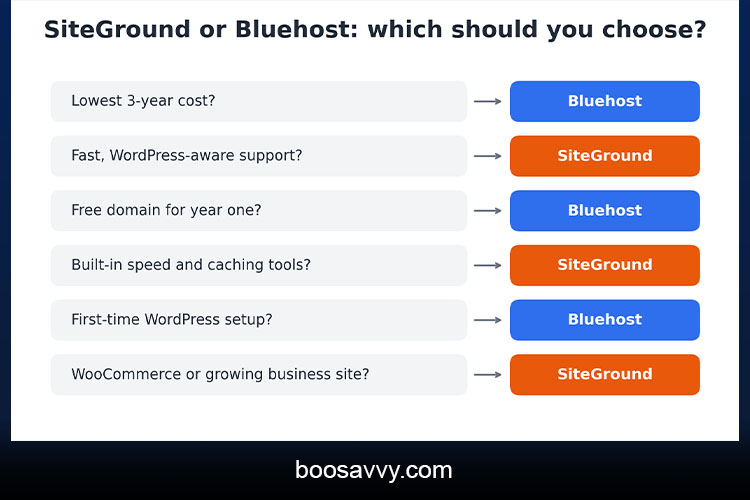
Choose SiteGround if you:
- Value fast, WordPress-aware support
- Want strong built-in caching and performance tools
- Don’t mind paying more at renewal
Choose Bluehost if you:
- Want the lowest starting cost, especially on a long-term plan
- Are a first-time WordPress user who wants guided setup
- Prefer a longer promotional pricing window
SiteGround Bluehost Pricing Comparison
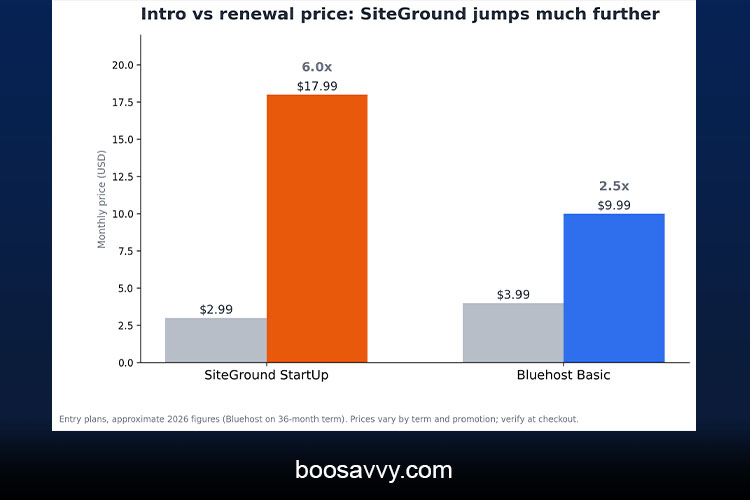
The SiteGround/Bluehost pricing story comes down to one thing: year one versus year two.
| Entry plan | StartUp | Basic |
| Intro price | About $2.99/mo | About $3.99/mo (36-month term) |
| Promo length | First year only | Up to 3 years |
| Renewal price | About $17.99/mo | About $9.99/mo (36-month term) |
| Free domain | Not typically included | Commonly included for year one |
Prices will vary by plan, term and promotion and figures for Bluehost from various sources are different, so you’ll need to check the actual pricing at checkout. One reviewer has Bluehost’s Starter renewal as high as $15.99 a month on a monthly basis, which is why it’s important to check the renewal terms.
Renewal Rates: Where the Real Cost Hides
SiteGround’s StartUp plan actually starts off cheaper than Bluehost’s entry plan. The first renewal, though, tells a very different story. The renewal rates for their three shared plans are reported at $17.99, $29.99 and $44.99 a month, respectively. That’s roughly 5 to 6 times the introductory rate on the entry plan, by far the biggest increase of any of the major budget hosts.
Bluehost renewals are pretty much double the introductory price, painful but still lower in absolute terms. Over three years, Bluehost is generally the cheaper choice. SiteGround, on the other hand, asks you to pay for what its fans call the intangible benefits: support, tooling and speed. The practical advice is to look at the three-year total rather than the first-year price.
SiteGround vs Bluehost Speed Test Results
Speed claims need to be qualified, as every SiteGround vs Bluehost speed test will be using different servers, different locations and different tools.
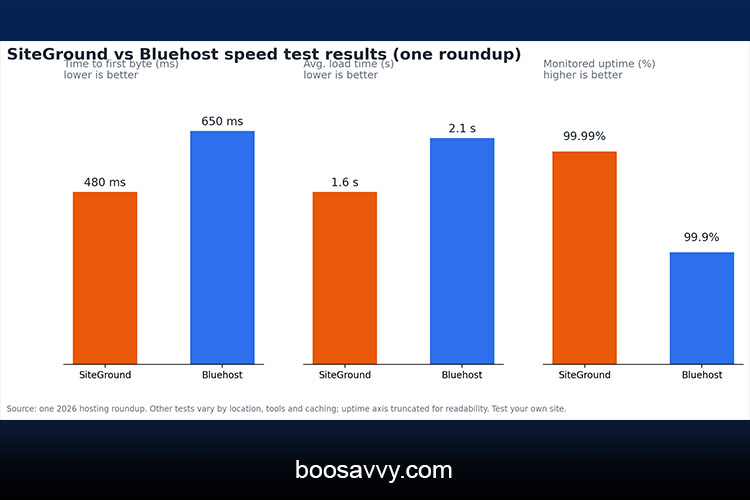
One round-up had SiteGround coming out on top at 480ms to first byte and an average load time of 1.6 seconds as opposed to Bluehost’s 650ms and 2.1 seconds. Another review saw SiteGround in a better position in a WordPress performance test (3rd vs 8th for Bluehost). A third test run from the Netherlands had SiteGround at 96% on GTmetrix.
Not every test agrees. A Hostinger-published comparison referenced independent 2025 benchmarks which showed SiteGround at 632ms (without a CDN), which was below Bluehost, and a critic of both hosts described their speed as mediocre. Take that as a competitor’s view of the situation, but it does underline why you should test your own site.
| Avg. TTFB (one roundup) | 480 ms | 650 ms |
| Avg. load time | 1.6 s | 2.1 s |
| Uptime (monitored) | 99.99% | 99.9% |
| Uptime guarantee | 99.9% | 99.9% |
Uptime and Reliability
Both hosts have a 99.9% uptime guarantee, and independent monitoring has generally been good for both of them. In one 3-month test, neither had an outage. Another test saw SiteGround at 99.99% and Bluehost at 99.9% over the duration of the test. The difference is minor, really, as 99.9% is approximately 9 hours of downtime per year and 99.99% is less than an hour. It’s a difference that will matter more to a business than it will to a blog.
Features and Infrastructure
SiteGround is entirely on Google Cloud (across 11 data centres with private fibre), and their custom PHP setup is said to be circa 30% faster on the higher tier plans. They also include caching, a CDN and staging tools, which are useful for sites that are growing.
Bluehost upgraded its infrastructure in 2026, which presumably fixed the old complaint that it was slow outside the US. They now offer a wider range of hosting options (VPS and dedicated servers amongst others) so you can scale within the same company. SiteGround’s upgrade path is via their cloud plans.
Ease of Use and Dashboard
SiteGround have replaced cPanel with their own Site Tools dashboard, which is clean and includes speed controls, caching and Cloudflare integration. Bluehost have a blended approach of a custom dashboard alongside cPanel and a guided WordPress install, and one of the reviewers found that to be the easier of the two for complete novices.
If you’re able to switch hosts at a later stage, then cPanel skills are very transferable. If you’re after fewer clicks to a fast site, then SiteGround’s tools are hard to beat.
Customer Support
Support is what gets SiteGround to the premium end of the market. It’s consistently described as fast and knowledgeable, with 24/7 chat and phone support, and the agents are clearly WordPress-savvy. One reviewer had a recurring WooCommerce error which SiteGround’s team fixed in around 20 minutes (Bluehost’s team had completely missed it on two occasions). Bluehost support is certainly solid and is improving, but it’s not really described as being the benchmark.
Security and Backups
Both hosting providers include free SSL certificates and basic malware protection. SiteGround also integrates security features and daily backups into its hosting plans, while Bluehost generally requires additional paid features for more advanced malware scanning and backup options. Regardless of your choice, maintaining independent offsite backups is essential, as your hosting provider’s backups should serve as an extra layer of protection rather than your only backup solution.
Which host should you choose?
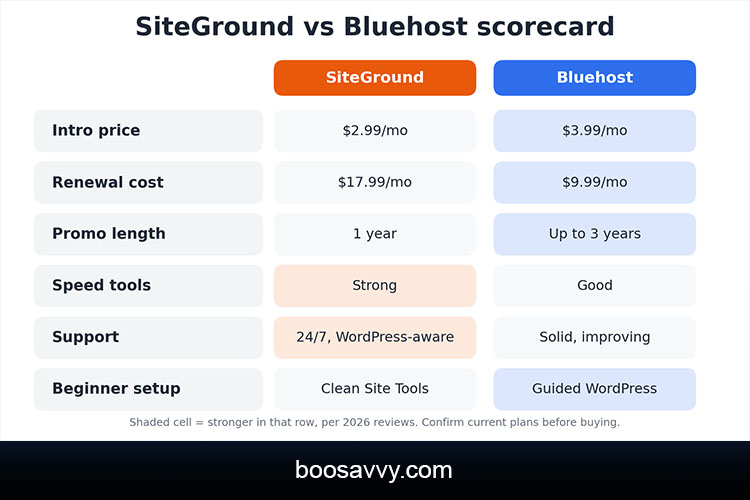
For the first-time blogger watching every penny, Bluehost wins on the long-term offer and the lower renewal rate. For a business site, a WooCommerce store, or anyone who wants that quick expert handholding, SiteGround’s premium price is definitely worth it. Neither of them is the best value in all circumstances, so you need to pick the host that best fits your own requirements.
Conclusion
The SiteGround vs Bluehost verdict is all about price versus polish. Bluehost comes out on top in terms of initial cost, length of the promotion and size of the renewal. It’s very attractive to novices and those on a tight budget. SiteGround wins on support, performance tooling and the infrastructure, but the renewal prices are quite steep. Look at the three-year totals, read the renewal terms before you go to checkout and do your own speed test during the money-back period. If you’re going to prioritise support and speed, then SiteGround is the one to pick. If budget is your primary concern, then Bluehost is the one.
FAQs
Is SiteGround better than Bluehost?
SiteGround is generally the better of the two in terms of support and performance tools; Bluehost is the cheaper option over the long term. Which is better depends on your priorities.
Which is cheaper, SiteGround or Bluehost?
SiteGround’s entry price is slightly lower, but Bluehost is usually cheaper over three years because its renewal rates are much lower.
Which is faster, SiteGround or Bluehost?
Most tests favour SiteGround, though results vary by location, tool and caching setup. Test your own site during the refund period.
Why is SiteGround so expensive at renewal?
It prices around support, managed WordPress features and Google Cloud infrastructure, and its entry plan renews at roughly five to six times the intro rate.
Which has better customer support?
SiteGround is widely praised for fast, WordPress-aware 24/7 chat and phone support. Bluehost is solid but less often called the benchmark.
Which is better for beginners?
Bluehost’s guided setup and lower costs suit many first-timers, while SiteGround suits beginners who value hands-on help.
Do both host WordPress sites well?
Yes. Both are officially recommended by WordPress.org and offer one-click installs.
Do SiteGround and Bluehost offer a free domain?
Bluehost commonly includes a free first-year domain, while SiteGround typically does not. Check current offers.
What uptime can I expect from each?
Both advertise 99.9%, and independent monitoring has generally shown near-perfect results for both.
Can I switch from one host to the other?
Yes. Both support WordPress migrations, and SiteGround and Bluehost each offer migration tools or assistance.